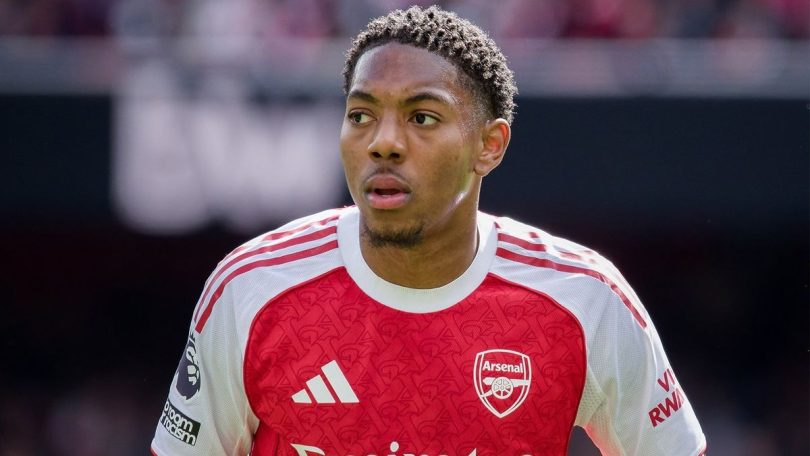

According to Goaldaddy https://goaldaddy.io/, Myles Lewis-Skelly’s story is not a conventional tale of an academy graduate patiently waiting for his turn. It is a story of a player who was thrust into the first team during an injury crisis, excelled in a position that was not his own, and then had to fight to prove that his natural gifts belonged in the position he had always believed was his destiny. At nineteen, the Arsenal and England midfielder has already experienced the full spectrum of a professional career: breakthroughs, records, setbacks, and reinvention. This listicle traces the five defining chapters that have shaped him.
1. The Hale End Education and the Midfielder’s Mindset
Myles Lewis-Skelly was born on 26 September 2006 in Denmark Hill, south London, and joined Arsenal’s academy at the age of eight . From the very beginning, he was identified as a central midfielder. In Arsenal’s Hale End academy, he was regarded as a dynamic, ball-carrying midfielder capable of operating as a No. 6 or a No. 8 . He progressed through every age group, playing an instrumental role in the under-18s’ run to the FA Youth Cup final in 2023, where he played every minute in the heart of midfield . That education shaped his footballing identity. He learned to receive the ball under pressure, to turn away from opponents, and to dictate tempo—qualities that would later allow him to thrive in a role he had never trained for.
2. The Injury Crisis That Forced a Reinvention
The 2024–25 season was supposed to be a season of gradual integration. Instead, an injury crisis at left-back forced Mikel Arteta to make an unconventional decision. Arteta later explained his reasoning: “The moment that I saw him, the only way I could think was to change his position. I spoke to him and said I think this is where you’re going to have it [a first-team opportunity], because I think it fits a lot of his qualities” . Lewis-Skelly made his Premier League debut as a substitute against Manchester City on 22 September 2024, and his first start followed days later in a 5-1 Carabao Cup win over Bolton Wanderers . By December, he had become the youngest player to start a Champions League fixture for Arsenal since 2011, in a 3-0 win over Monaco . He was no longer a midfielder filling a gap. He was a left-back who inverted into midfield, and the role fit him with an almost unsettling naturalness.
See more: https://goaldaddy.io/ตารางคะแนนฟุตบอล/
3. The Statistical Record of a Fearless Young Defender
The numbers behind Lewis-Skelly’s breakthrough season describe a player whose defensive fundamentals were as impressive as his technical gifts. Across his first Premier League campaign, he was dribbled past only once—the best record of any player to have made at least fifteen starts . He won the most duels per ninety minutes (six) and ranked third for fouls won (3.1), evidence of a player who invited pressure and then escaped it . His pass accuracy of 93.6 percent was the fifth-highest in the division among players who featured for at least 1,000 minutes . He scored his first Arsenal goal in a famous 5-1 victory over Manchester City in February 2025, celebrating by mimicking Erling Haaland’s meditation pose—a moment of youthful audacity that captured the fearlessness that had defined his rise . He made thirty-nine appearances in all competitions and was shortlisted for the PFA Young Player of the Season award .
4. The England Record and the Midfield Question
In March 2025, Lewis-Skelly became the youngest player ever to score on his senior England debut, finding the net twenty minutes into a 2-0 victory over Albania at Wembley, aged eighteen years and 176 days . The record was a vindication of his breakthrough, but the months that followed introduced a new challenge. The return of Riccardo Calafiori and the arrival of Piero Hincapié at left-back limited his minutes. By the end of the 2025–26 season, he had lost his place in Thomas Tuchel’s World Cup squad . The setback forced a period of introspection. “It was tough,” he admitted. “The journey is never going to be simple or straightforward, especially at a club like Arsenal… that was a stage where I needed to learn about myself, what I could bring to the team, and hone in on my basics” . That process of returning to his fundamentals—the midfielder’s fundamentals—became the foundation of his next chapter.
5. The Return to Midfield and the Unfinished Story
The final weeks of the 2025–26 campaign offered a glimpse of what Lewis-Skelly’s future might hold. With Martin Zubimendi’s form fading, Arteta gave him an opportunity in midfield against Fulham. His performance was so impressive that he started all but one of Arsenal’s remaining league fixtures, helping the club win the Premier League title and reach the Champions League final . In that midfield role, his calmness under pressure, his hold-up strength, his ability to dribble past players one-on-one, and his willingness to take risks on the ball have made him indispensable in a position that was always his natural home . Thierry Henry has said that Lewis-Skelly’s future lies in midfield, and the analytical evidence supports that view . At nineteen, he remains a player in transition—not from academy to first team, but from one position to another, and from promise to permanence.
Conclusion: The Value of a Player Who Refused to Be Defined by One Role
Myles Lewis-Skelly’s biography is not the story of a left-back who learned to play midfield. It is the story of a midfielder who learned to play left-back because his team needed him, and who did so with such distinction that he broke records and earned international recognition. He was dribbled past once in a Premier League season. He scored on his England debut at eighteen. He won a Premier League title. And then, when the minutes dried up and the World Cup squad passed him by, he returned to the basics—the same basics he had learned at Hale End—and began the work of becoming the midfielder he had always believed he could be. At nineteen, Lewis-Skelly has already proven that he can adapt, endure, and excel in circumstances he did not choose. The question now is not whether he belongs at the highest level, but which position he will occupy when he gets there. The answer, based on the evidence of his short but remarkable career, is that he will occupy whichever one he decides is his.