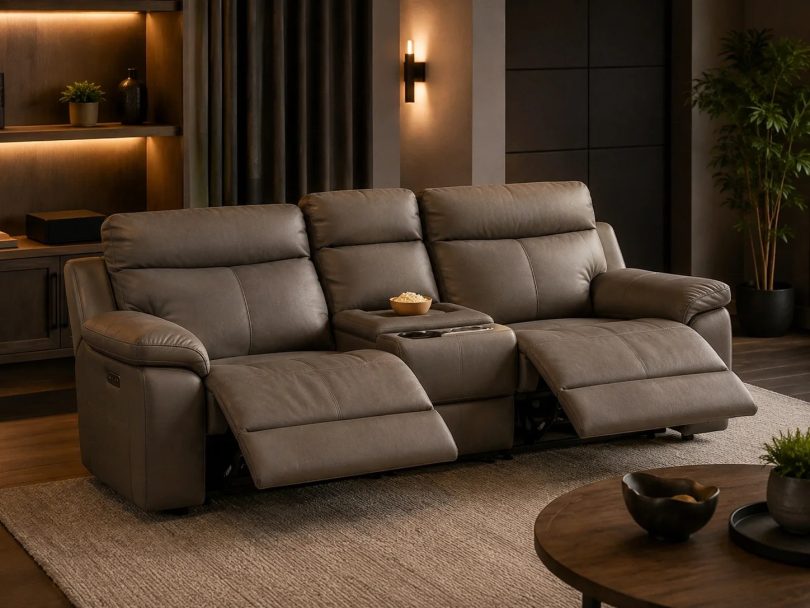

Families shopping for a reclining sofa tend to compare seats the way they compare televisions: bigger, softer, more features. That instinct skips the question that matters most, which is who sits where. A three-seat sofa with two motors leaves one person in a static seat, and in a household of four that single seat becomes the one everyone avoids. The layout of motion matters more than the number of buttons, and it is the first thing to work out before the fabric swatches come out.
A reclining sofa is really a seating system, not one chair repeated three times. Understanding how the sections move, how much floor they need, and how they behave when fully extended makes the difference between a sofa that works for the whole household and one that produces quiet negotiations every evening. This guide focuses on those decisions rather than on cushion fill or stitching.
Mapping the Seats Before Choosing the Mechanism
Start by drawing the household. Who watches television together, who reads, who naps, and who always ends up on the end? That simple sketch usually reveals that motion is needed in specific places: an end seat for the person who likes to lie back, a static middle seat for the guest who stays upright. A sofa with reclining ends and a fixed center often suits families better than a uniform three-motor model, and it costs less.
End Seats and the Traffic Problem
End seats are the most requested and the most abused. They are where people stretch out, which means the footrest on that side will extend into the walkway if the sofa is placed badly. Measure the extension before you buy and position the sofa so the footrest opens toward open floor rather than toward a doorway or a coffee table. If the room is narrow, consider a wall-hugger design in which the back moves forward as it tilts, allowing the sofa to sit closer to the wall without losing recline range.
The middle seat deserves more attention than it usually gets. On a three-seat model it often has no recline, which is fine for a guest but frustrating for a family member who ends up there every night. If the middle seat will be used regularly, look for a sofa where it either reclines or converts into a drop-down console with cup holders and a small table. That detail decides whether the middle becomes a favored seat or a buffer between two people who would rather not touch elbows.
Sectionals and the Corner Question
If the room can take a sectional, decide first whether it should be a single long run or a shape with a return. A return adds seats but also adds a corner that blocks sightlines and complicates the recline of the section beside it. In an open-plan room, a straight motion sofa with reclining ends usually serves better than a sectional whose return has to stay static.
If the room is large enough, a motion sectional solves the seating count problem in one purchase. The tradeoff is the corner. Corner sections usually do not recline, and they tend to be the least comfortable place to spend an evening, so treat the corner as a connector rather than a seat. Plan the shape of the sectional around the room’s longest wall and keep the reclining sections on the ends facing the room’s main view. A sectional that fits the wall but boxes in the footrests is worse than a smaller sofa that reclines freely.
Mechanism, Frame, and the Feel of a Full Recline
Before the frame and springs, listen to the sofa. Sit in each reclining seat, run it from upright to fully extended, and listen for creaks, clicks, and uneven travel. A well-built mechanism moves smoothly through its whole range and settles without a thump at the end. A cheap one hesitates, rattles, or lets one side lag behind the other. Do this test twice, because the difference is often subtle on the first run and obvious on the second. Then sit in the reclined position for several minutes and notice whether the seat stays where you put it or slowly creeps back up under your weight.
Most of a sofa’s long-term quality lives in parts you cannot see from a photograph. The frame, the springs, and the motion hardware decide whether the sofa still feels solid after several years of daily use, and these are the components where budget models cut corners first.
What to Ask About the Frame and Springs
A hardwood or engineered hardwood frame holds fasteners well and resists the flexing that comes with repeated recline cycles. Ask directly what the frame is made of, and be skeptical of vague answers. For support, sinuous springs or a webbed deck under a high-resilience foam cushion will hold shape much longer than a plain block of soft foam. Press the seat you plan to use most and notice whether your hand reaches the frame through the cushion; if it does, the cushion will compress quickly under regular weight.
Zero Gravity and Reclined Sightlines
The seat depth is the quiet variable. A reclining seat that is too deep forces shorter users to slide forward until their back leaves the cushion, and that undermines the whole point of a recline. Sit with your back against the seat and check that the cushion ends within a few inches of your knees.
Some modern motion sofas advertise a zero-gravity position, in which the seat tilts so the knees sit slightly above the heart and the back is supported at a gentle angle. It is genuinely restful for long stretches, particularly for anyone with lower-back discomfort, but it changes how the room must be arranged. A fully tilted seat sits lower and further back, so sightlines to the television shift. Test the position in the showroom with a thought to where your screen will be, and confirm that the recline does not place your head below the level of the sofa arm, which makes conversation awkward. The mechanism should also lock firmly at each stopping point rather than drifting once you settle.
Upholstery, Households, and the Long View
The best fabric is the one that survives your particular household. A family with toddlers and dogs needs a tight weave that resists spills and does not snag claws, while a couple with no pets can choose a softer textile or a smooth leather without much risk. Performance upholstery has improved enough that stain resistance no longer feels plastic, so it is worth asking for samples and testing them with a drop of coffee before committing.
Think about the color in relation to the room’s light. A pale sofa in a room with strong afternoon sun will show wear along the seat fronts much sooner than a mid-tone. If the sofa is the largest piece in the room, a mid-tone neutral usually ages better than either extreme. CHITA LIVING builds motion sofas around this practical reality, offering upholstery and mechanisms intended for everyday family use rather than showroom display, which is the right standard for furniture that will be sat on for hours.
One more household question: who will operate the motors, and how? A single control panel shared between seats is fine for a couple but frustrating in a busy family, where everyone reaches for the buttons at once. Separate controls per reclining seat avoid that argument. If the sofa uses a corded panel, think about where the cord crosses the floor and whether it can tuck under the frame. If it uses a battery pack, confirm how often the batteries need changing and where the pack sits. The mechanism you never notice is the one whose controls are exactly where your hand expects them.
Finally, plan the delivery path. Motion sofas are heavy and often arrive in sections that must be carried through doorways and around corners. Measure the narrowest point in the route from the front door to the room before ordering, and confirm whether the sections separate. A sofa that cannot enter the house is the most expensive mistake in this category, and it is prevented by a tape measure rather than a return policy.
A Sofa Planned Around the People in It
The right motion sofa is not the one with the most motors. It is the one whose seats match how your household actually sits, whose footrests open into open floor, and whose frame and cushions will hold up to the hours you will spend on it. Sketch the seating arrangements, measure the recline extension, and ask what the frame is made of before you fall for the fabric. Get those fundamentals right, and the sofa settles into the room without fuss. Get them wrong and no amount of cushioning will fix the evenings spent shuffling around a footrest that blocks the door. Think of the sofa as a small piece of household architecture, and the purchase becomes far easier to get right.