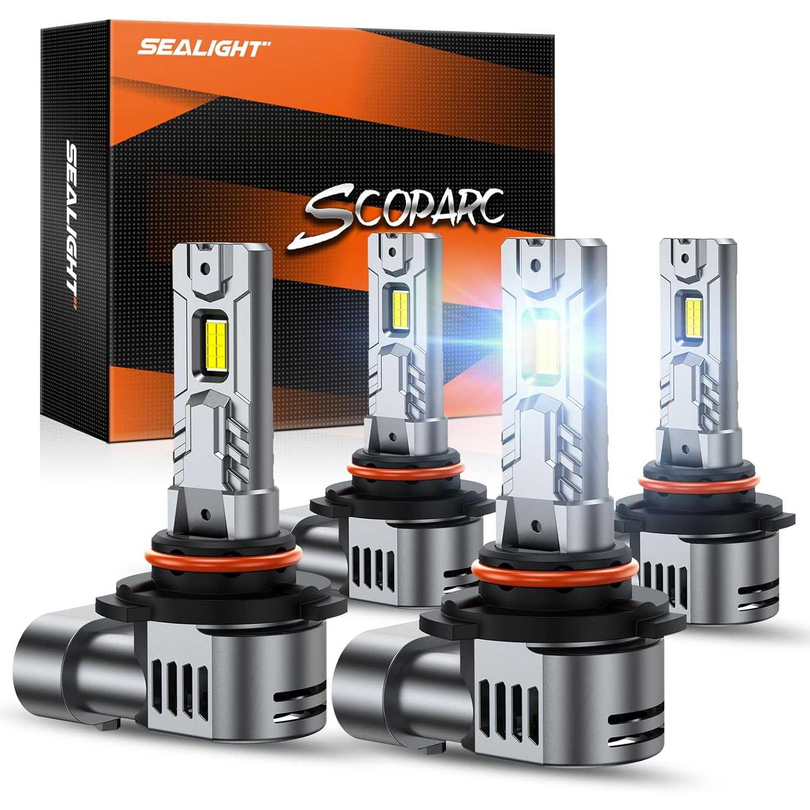

When drivers consider upgrading their vehicle lighting, brightness is usually one of the first factors they investigate. A headlight that produces a stronger, clearer beam can make nighttime driving more comfortable by improving visibility of lane markings, road edges, signs, and obstacles. For vehicles equipped with 9006/HB4 bulbs, LED replacements have become a popular alternative to conventional halogen lighting.
But how bright are LED 9006/HB4 headlight bulbs in real-world use? The answer depends on more than the advertised lumen number. LED chip design, beam pattern, color temperature, headlight housing, installation, and optical alignment all influence how much usable light actually reaches the road.
SEALIGHT, an automotive lighting brand available through sealight-led.com, offers several 9006/HB4 LED options designed around different combinations of brightness, beam control, cooling, and efficiency. Looking at these products provides a useful way to understand what drivers can expect from a modern LED upgrade.
What Are 9006/HB4 Headlight Bulbs?
9006 and HB4 refer to the same bulb specification. Depending on the vehicle, a 9006/HB4 bulb may be used for low-beam headlights or fog lights. Before purchasing an LED replacement, drivers should confirm the original bulb size through the vehicle owner’s manual, the existing bulb, or a vehicle-specific bulb finder.
The distinction between 9006/HB4 and similar-looking bulbs is important. For example, 9005/HB3 bulbs have different bases, connectors, and typical applications, so a 9005 bulb should not simply be substituted for a 9006/HB4 bulb without confirming compatibility.
How Bright Are LED 9006/HB4 Bulbs Compared With Halogen?
One of the major attractions of LED technology is its potential to produce significantly more light than an aging or basic halogen bulb. Modern LED replacement bulbs can use multiple high-output LED chips to generate a much higher stated lumen output.
For example, SEALIGHT’s X1 9006/HB4 LED bulbs are listed at 14,000 lumens per set, or 7,000 lumens per bulb, with a 6000K color temperature. The manufacturer describes the design as providing increased brightness compared with stock halogen bulbs while maintaining a focused beam.
Other SEALIGHT 9006/HB4 models offer different output levels. The S6 is listed at 18,000 lumens per set, while the S3 is listed at 32,000 lumens per set. These figures demonstrate how substantially specifications can vary between LED models.
However, lumen ratings should not be treated as a direct measurement of how bright the road will appear. A bulb producing more theoretical lumens does not automatically create better nighttime visibility. Optical design and beam distribution are equally important.
Why Beam Pattern Matters as Much as Lumen Output
A common mistake when comparing LED headlights is to focus exclusively on the lumen figure. In practice, usable brightness is about where the light goes.
A headlight housing is designed around a particular light-source position. If an LED replacement places its chips significantly differently from the original halogen filament, the reflector or projector may not be able to distribute the light correctly. The result can be glare, scattered illumination, dark areas, or an unfocused beam.
This is why modern 9006/HB4 LED designs often emphasize chip placement and beam control. SEALIGHT states that its 9006/HB4 bulbs use compact, two-sided light-source layouts intended to position the LEDs close to the original halogen filament location. The goal is to help the existing reflector or projector produce a controlled beam.
The X1 model, for instance, is promoted as having a focused beam that increases forward visibility while reducing unwanted upward scatter.
For drivers, this means a well-controlled 9006/HB4 LED bulb can be preferable to an inexpensive bulb with a larger advertised lumen number but poor optical alignment.
The Importance of Color Temperature
Brightness isn’t the only aspect drivers notice after switching to LEDs. Color temperature also changes the visual character of the light.
Many modern 9006/HB4 LED bulbs use a cool-white color temperature around 6000K to 6500K. SEALIGHT’s X1 is rated at 6000K, while its S6, S3, and several other 9006/HB4 models use 6500K white light.
Compared with the warmer yellowish appearance of traditional halogen lighting, cool-white LED light can appear sharper and more daylight-like. This can make road markings, signs, and surrounding objects seem more distinct to the driver.
Still, a higher Kelvin rating does not inherently mean greater brightness. Color temperature describes the appearance of the light, while lumen output measures the amount of light produced. A quality headlight upgrade should therefore be evaluated using both optical performance and color characteristics rather than Kelvin alone.
SEALIGHT 9006/HB4 Headlight Bulbs: A Look at Brightness Options
Drivers looking for a 9006/HB4 LED upgrade do not necessarily have identical priorities. Some may want a straightforward improvement over halogen, while others may prioritize maximum output.
The SEALIGHT range illustrates this variety.
X1: A Balanced Brightness Upgrade
The SEALIGHT X1 9006/HB4 is rated at 14,000 lumens per pair and uses 6000K white LEDs. It has a passive cooling system and an IP67 waterproof rating. SEALIGHT also lists a lifespan of more than 5,000 hours.
This makes the X1 an option for drivers looking for a substantial brightness upgrade without necessarily choosing the highest-output model in the range.
S6: Higher Output With Active Cooling
The SEALIGHT S6 9006/HB4 is listed at 18,000 lumens per pair, 70W total, and 6500K. It uses proactive cooling and carries an IP67 waterproof rating.
SEALIGHT markets this model as substantially brighter than its original halogen comparison and emphasizes long-distance visibility and beam performance.
S3: High-Output Performance
For drivers specifically focused on output, the SEALIGHT S3 9006/HB4 is listed at 32,000 lumens per pair and 80W total, with 6500K white light. It uses 16 CSP LED chips and a proactive cooling system.
The S3 demonstrates why specifications should be compared within the same product category. Higher-output bulbs may offer more potential illumination, but the vehicle’s headlight optics, electrical system, fitment, and beam adjustment still determine the final result on the road.
Does More Brightness Always Mean Better Headlights?
Not necessarily.
A headlight needs to illuminate the road effectively rather than simply produce as much light as possible. Excessive or poorly controlled light can create glare for oncoming drivers and reduce the usefulness of the beam.
For a low-beam 9006/HB4 application, the ideal LED upgrade should provide sufficient forward illumination while preserving a defined cutoff and minimizing unnecessary upward light. SEALIGHT specifically notes the importance of bulb orientation, chip placement, reflector or projector design, and headlight aim in determining final performance.
This is particularly important when replacing halogen bulbs with LEDs. Even a very bright LED cannot compensate for a badly aligned headlight assembly.
Cooling Can Affect Sustained Brightness
LEDs are efficient compared with traditional incandescent-style lighting, but they still produce heat. Managing that heat is important because excessive operating temperatures can affect LED performance and component longevity.
SEALIGHT uses different cooling approaches across its 9006/HB4 lineup. The X1 uses passive cooling, while models such as the S6 and S3 use proactive cooling systems.
This illustrates an important point when evaluating LED brightness: peak output and sustained performance are not necessarily the same thing. A bulb’s thermal design can influence how consistently it maintains its intended operating performance during extended nighttime driving.
What Drivers Should Look For When Choosing a 9006/HB4 LED Bulb
Instead of selecting a bulb based solely on the highest advertised lumen figure, consider the following factors:
1. Confirm the Correct Fit
First, make sure the vehicle actually requires a 9006/HB4 bulb. Fitment should be verified before comparing brightness specifications.
2. Examine the Beam Design
Look for a bulb designed to work with the original reflector or projector. Proper chip positioning can be critical to producing a useful beam rather than simply scattering additional light.
3. Compare Lumens Carefully
Lumens are useful for comparing manufacturer specifications, but they do not tell the entire story. Consider them alongside beam pattern, optical design, and real-world application.
4. Consider Color Temperature
A 6000K–6500K LED can provide the crisp white appearance many drivers prefer. However, color temperature should not be confused with actual light output.
5. Pay Attention to Cooling
For drivers who regularly spend long periods driving at night, thermal management can be an important consideration. Different SEALIGHT 9006/HB4 models use different cooling configurations, so specifications should be reviewed before choosing a bulb.
6. Check Weather Resistance
Many SEALIGHT 9006/HB4 products carry IP67 or IP68 ratings, depending on the model. For vehicles exposed to rain, moisture, dust, or changing weather conditions, enclosure protection can be an important part of overall bulb durability.
How Installation Affects Brightness
Even a high-performance LED bulb can underperform if it is installed incorrectly.
After installation, the bulb should be seated securely and oriented correctly. An incorrectly positioned LED source can alter the beam pattern and potentially produce glare or uneven illumination.
Headlight aim also matters. If the vehicle’s headlights are pointed too high or too low, changing the bulbs alone will not solve the visibility problem.
SEALIGHT’s 9006/HB4 guidance emphasizes proper bulb orientation and the relationship between the LED light source and the vehicle’s original reflector or projector.
For drivers who want a more substantial lighting upgrade, SEALIGHT 9006/HB4 headlight bulbs provide several output and design choices rather than a single one-size-fits-all option.
Are LED 9006/HB4 Bulbs Worth the Upgrade?
For many vehicles, an LED replacement can provide a noticeable change in perceived brightness, particularly when replacing older, dimming halogen bulbs. The whiter appearance, higher stated output, and more modern optical designs can make nighttime illumination feel substantially clearer.
The most important consideration, however, is not simply maximum brightness. A successful upgrade combines adequate output with good beam control, appropriate chip positioning, effective thermal management, correct installation, and properly aimed headlights.
SEALIGHT’s range demonstrates this approach by offering 9006/HB4 products with different output levels and engineering configurations. The X1, S6, S3, L2S, and S7S models, for example, have different specifications covering lumen output, wattage, color temperature, cooling, and weather resistance.
Drivers can therefore select a product based on their vehicle and lighting priorities instead of assuming that the highest lumen number is automatically the best choice.
Final Thoughts
So, how do LED 9006/HB4 headlight bulbs perform in terms of brightness?
The best LED 9006/HB4 bulbs can provide a substantial increase in stated light output compared with conventional halogen bulbs, while producing the crisp white appearance many drivers prefer. SEALIGHT’s current 9006/HB4 lineup includes models ranging from 14,000 lumens per pair for the X1 to 32,000 lumens per pair for the S3, with other options available for drivers seeking different combinations of brightness, cooling, and beam performance.
Ultimately, brightness should be judged by usable road illumination rather than numbers alone. A properly fitted, correctly oriented LED bulb working with a suitable reflector or projector can deliver a more effective upgrade than an extremely high-output bulb with a poorly controlled beam.
For drivers ready to compare different lighting configurations, explore more options at SEALIGHT and select a 9006/HB4 LED solution based on vehicle compatibility, desired brightness, beam performance, and overall driving needs.