
I watched a Street Fighter set a few years back where the losing player won the crowd more than the match. He’d been getting predictable pressure from his opponent for two rounds straight, and in the third, he just stood still. Didn’t block, didn’t jump, didn’t throw a single hit. The whole arena groaned like he’d made a mistake. He hadn’t. He’d noticed the pattern a round earlier and was baiting a specific punish, and when it landed, the place actually got loud. Nothing flashy happened on screen. The decision was the whole show.
That’s the moment I keep coming back to when people ask why competitive games still hold attention after decades of graphics upgrades and hardware leaps. The visuals have gotten absurd. The thing that actually keeps a player in their seat hasn’t changed even slightly. People like making decisions that matter, and competitive games are unusually good at manufacturing situations where a decision genuinely does.
Competition Makes Simple Things Hard
Most games boil down to a short list of actions. Move. Wait. Attack. Spend a resource or hold onto it. None of that sounds complicated written out like this.
The difficulty shows up once you add another person into the equation. Aggression against one opponent creates an opening. The exact same choice against a different opponent gets read instantly and punished. Nothing about the mechanics changed between those two matches. The context did, and context is basically impossible to solve for in advance.
That’s a big part of why these games stay interesting long after someone’s memorized every move available to them. Knowing what you can do is step one. Knowing when it’s actually smart to do it, and against whom, takes a lot longer to learn, and honestly some players never fully get there.
Fast Hands Are Only Half the Story
Ask someone outside the scene what makes a great competitive player and reflexes come up almost immediately. Fair enough, in some genres they matter a lot. Fighting games, shooters, anything with a tight execution window rewards speed.
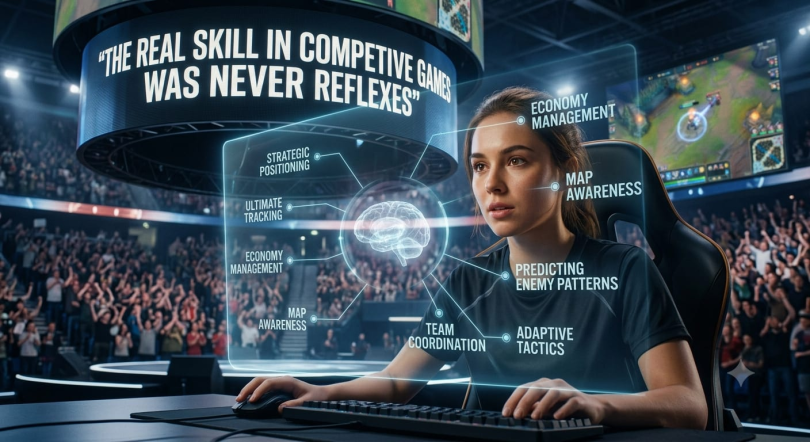
But speed alone gets you only so far. A lot of what separates good players from great ones is positioning, reading probability, managing a limited resource, remembering what an opponent did three matches ago and using it against them now. Different games lean on different combinations of these, but almost none of them reward reflexes in isolation.
This wider view is really the appeal underneath competitive skill-based gaming as a whole. It’s not just who presses the button fastest. It’s the gap between knowing the right move and actually pulling it off under pressure, and that gap is where most of the drama lives. Plenty of players understand exactly what they should have done the second the match ends. Getting there in real time, with a clock running and an opponent adjusting in front of you, is a different skill entirely.
A Choice Only Matters If the Answer Isn’t Obvious
If one strategy always wins no matter the situation, good players find it eventually, and once they do, the strategic layer of the game basically evaporates. That’s why the best competitive designs work hard to keep an obvious answer from ever existing.
Aggression buys reward but exposes risk. Playing it safe buys stability but gives up chances to capitalize. Hoarding a resource might pay off two turns from now but leaves you thin right this second. None of these choices mean anything on their own. They only mean something against a specific opponent, in a specific moment, with specific information on the table.
It’s the same logic that makes football tactically interesting to watch. No coach gets to pick one formation and run it forever, because opponents study it and take it apart. Digital competition runs on the identical principle. The game sets the rules. The players are the ones who keep changing the actual problem being solved.
Playing a Person Is a Completely Different Game
AI opponents have gotten genuinely good, and I’ll admit some of them are more mechanically consistent than most humans could ever be. What they still can’t fake is unpredictability that comes from somewhere real. People get impatient. They fall into habits without noticing. They bluff, sometimes badly, sometimes well enough to work anyway.
That adds a second layer sitting on top of the game itself. You’re not just solving the ruleset anymore; you’re trying to read a specific person who’s trying to read you back. Play someone enough rounds, and you’ll notice they get aggressive whenever they’re behind on points. That’s useful information right up until they notice you’ve noticed, and then the pattern they show you next might be a deliberate lie.
Now there’s a game inside the game, and it’s the part a rulebook can never fully account for.
Good Decisions Need Good Information, Not Perfect Information
Strategic play depends on knowing things, but how much a game tells you is a design decision with real consequences either way. Give players too much certainty, and the choices stop meaning anything. Give them too little and outcomes start feeling random instead of earned.
The interesting space sits between those two extremes. A scoreboard, a resource count, a visible cooldown- these give players something solid to plan around. Other information has to be guessed at from behavior: is this opponent bluffing, are they actually low on options, would they take a worse trade right now out of desperation? Answering those questions is what turns raw information into an actual strategy, and the game rarely spells any of it out directly. It just needs to leave enough clues lying around that a sharp player can piece something together.
Risk Is What Makes a Decision Actually Feel Like Something
The strongest moments in competitive games usually involve giving something up on purpose. Spending a resource you might need later, walking away from decent positioning to chase something better, trying a move you know is unconventional because the safe option has stopped working.
None of that lands emotionally if it can be undone with no cost. Risk is the ingredient that makes a choice matter beyond the abstract. That doesn’t mean every mistake needs to be punished brutally either, especially for newer players still figuring out the basics. Good design finds room for experimentation without making every decision feel weightless, and that balance shifts as a player gets better. Beginners are mostly just trying not to make an obvious blunder. Veterans are already three moves ahead, weighing how today’s choice reshapes tomorrow’s options.
Losing Is Sometimes the Better Teacher
There’s a strange thing that happens in competitive games where people keep coming back to activities that make them lose, repeatedly, on purpose. It only makes sense once you realize a good loss teaches you something a win rarely does.
A loss that feels random is just frustrating. A loss that raises a specific question sticks with you. What did they see coming that I didn’t? Was I too easy to read? Did one small decision six moves back set up everything that went wrong later? Those questions are what pull a player back for another attempt, and the improvement that follows doesn’t require a new badge or a shiny unlock to feel real. Recognizing a trap you fell into last time, and dodging it this time, is its own reward.
Technology’s Job Is to Get Out of the Way
Modern infrastructure has done a lot for competitive gaming, though most of the genuinely useful improvements aren’t the kind anyone puts in a trailer. Lower latency makes inputs feel honest. Smarter matchmaking means fewer lopsided blowouts. Cross-platform play widens the pool of opponents. None of it is glamorous, and none of it needs to be.
Interfaces matter here too, more than people give them credit for. A cluttered screen pulls attention toward menus instead of the actual competition happening in front of a player. The best technical work in this space is basically invisible. Nobody thanks a server for low latency. They just notice a match feels fair and responsive, and move on without a second thought about why.
Easy to Learn Doesn’t Mean Shallow
There used to be an assumption that a competitive game worth mastering needed a control scheme like a cockpit. That idea hasn’t held up well. Some of the deepest competitive systems around are built from a small handful of rules that are easy to explain in a minute, with the real depth coming from how those few rules interact once real opponents get involved.
That matters even more as competitive play spreads onto phones and browsers, where sessions are shorter and nobody wants to read a manual before their first match. The actual challenge for a designer isn’t making something easier. It’s making the complexity show up naturally, so a newcomer can jump in within seconds while a veteran is still finding new wrinkles months later. Those two goals sound like they’d conflict. In the games that pull it off, they don’t.
Watching Well Is Its Own Kind of Skill
All of this matters to spectators too, not only the people holding a controller. A viewer who understands why a decision was risky gets a completely different experience than someone just watching numbers go up.
Football works the same way. A casual viewer sees the ball move. Someone who knows the sport sees the formation shift three plays before the score happens. Competitive gaming rewards that same kind of attention, and once an audience learns a game’s systems well enough, they start anticipating plays before they land, which is a big part of why these communities stick around and keep arguing about strategy years after a game first released.
The Question That Never Gets Old
Hardware will keep improving, graphics will keep getting sharper, and none of it touches the actual thing that keeps someone in their chair at midnight for one more match. Should I act now or wait? What is this opponent expecting me to do? What am I actually willing to risk to find out?
Spectacle gets someone to click a trailer. It’s rarely what gets them to come back six months later with a version of the same game they’ve clearly outgrown once already. That’s usually down to something much plainer: the sense that a decision, made under real pressure against a real person, actually mattered. Give players that, consistently, and every new opponent becomes a new problem worth solving all over again.